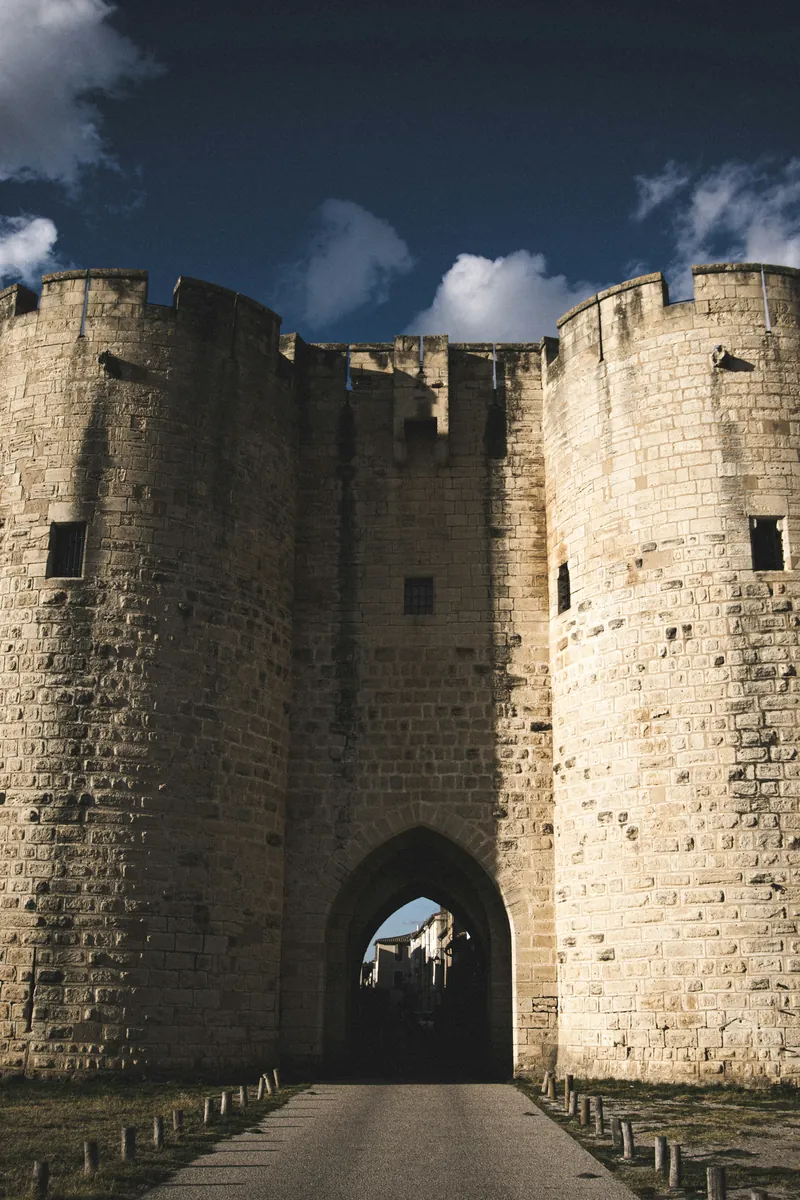
The medieval ramparts and the great cylindrical Tour de Constance of Aigues-Mortes rising above the flat Camargue, their pale stone glowing at golden hour with the salt lakes beyond. Aigues-Mortes, Occitanie, France.

Saint Louis's walled sea-city, its ramparts still whole after 750 years

Aigues-Mortes skip-the-line — climb the great Tour de Constance and walk the full 1.6 km circuit of thirteenth-century ramparts, unbroken all the way round, with the pink salt lakes of the Camargue shimmering below. This is the port King Louis IX built to sail for the Crusades, self-guided with the audio history included.

See ticket options
  • 1240 Founded by Louis IX as France's first royal Mediterranean port
  • 1,650 m Of thirteenth-century ramparts you can walk all the way round
  • 1248 & 1270 The port from which Saint Louis sailed for the Seventh and Eighth Crusades
  • Tour de Constance The great cylindrical keep, later prison of the Huguenot women

Choose your ticket

Ramparts & Towers ticket

Full visit — the Tour de Constance climb and the complete 1.6 km rampart circuit, self-guided, with the audio history included

€24

  • Skip-the-line, pre-booked entry to the towers and ramparts
  • The climb up the great Tour de Constance to its panoramic terrace
  • The full 1.6 km walk along the medieval ramparts, with Camargue panoramas
  • 5-minute audio history sent before your visit
  • Concierge support in your language, before and on the day
Notify me when bookings open
4.8 from 64 verified travellers
Helen P.
Manchester
“Walking the entire circuit of the walls is unforgettable — the little grid of streets on one side and the pink salt lakes stretching out on the other. The Tour de Constance is genuinely moving once you know the story of the Huguenot women. Booking ahead meant no queue in the heat.”
Markus L.
Munich
“We drove over from Montpellier for the afternoon and it was the highlight of the trip. The ramparts are completely intact, unlike anywhere else we've seen, and the views over the Camargue at golden hour were something else.”
Sofie D.
Antwerp
“The audio history they sent beforehand set everything up perfectly — Saint Louis sailing for the Crusades, then Marie Durand's thirty-eight years and the word carved in the stone. Standing in the Tour de Constance afterwards gave me goosebumps.”

5-minute audio guide

Your Aigues-Mortes 5-minute guide

Hand-written, narrated by a heritage host, sent to every customer the day before their visit. Five minutes that turns a wall of golden stone into a real story — the crusading king who built a port from a marsh, the ramparts that never fell out of time, and the women who carved a single word of defiance into a prison well.

Included with your booking — your full guide arrives with your ticket.Get your guide
  • Why Saint Louis built a brand-new sea-city on the empty salt marshes — and sailed from here for the Crusades
  • The Tour de Constance: from royal keep to the prison of the Huguenot women
  • Marie Durand's thirty-eight years and the word 'RÉSISTER' carved in the stone
  • How to read the view from the walls — the medieval grid, the salt lakes, and the wild Camargue beyond

Included free with every ticket. No app, no download — plays in any browser.

About Towers and Ramparts of Aigues-Mortes

Aigues-Mortes is one of the most complete medieval walled towns in France — a perfect rectangle of golden ramparts standing alone in the flat marshes of the Camargue, in Occitanie in the far south. It was founded in 1240 by King Louis IX, later canonised as Saint Louis, who needed a Mediterranean port that answered to the French crown alone rather than to the Italian maritime republics or a foreign lord. On this reclaimed salt-marsh — the name means 'dead waters' — he laid out a new town on a grid and began the great cylindrical keep now called the Tour de Constance. From here, in 1248 and again in 1270, Saint Louis set sail with his fleets for the Seventh and Eighth Crusades.

The ramparts that ring the town were built through the thirteenth and fourteenth centuries, the walls begun in earnest under his son Philip III the Bold from 1272 and completed over the following decades. Because Aigues-Mortes was never remodelled or heavily restored in the nineteenth century, its 1,650-metre circuit of walls, gates and towers survives almost exactly as it was raised — an unbroken medieval enceinte you can walk the whole way round, looking out over the town's chequerboard of streets on one side and the shimmering salt lakes of the Salins du Midi on the other.

At the northwest corner stands the Tour de Constance, the mightiest of the towers, built by Louis IX between 1242 and 1254 with walls six metres thick at the base. In later centuries it became a prison, and after the Revocation of the Edict of Nantes in 1685 it held Huguenot women who refused to renounce their Protestant faith. The most famous of them, Marie Durand, was imprisoned here for thirty-eight years; on the stone kerb of the tower's well she is said to have carved the single Occitan word 'RÉSISTER' — resist — which visitors can still read today. Managed by the Centre des monuments nationaux, the monument is a self-guided visit: climb the tower, walk the walls, and let 750 years of history unfold around you.
Practical information

Opening hours
Open daily, with seasonal hours. From 2 May to 31 August: 10:00–19:00. From 1 September to 30 April: 10:00–17:30 (10:00–16:30 on 24 and 31 December). Last admission is 45 minutes before closing. Closed on 1 January, 1 May and 25 December. Hours can vary, so check when you book.
Address
Tours et remparts d'Aigues-Mortes, Logis du Gouverneur, 30220 Aigues-Mortes, France
Getting there
In the walled town of Aigues-Mortes in the Camargue, Occitanie — about 27 km east of Montpellier and 33 km southwest of Nîmes. By train, the TER liO line links Nîmes to Aigues-Mortes station, around 450 m from the walls. By car, from Nîmes take the A9 (exit 26) then the D6313 and D979; from Montpellier the A9 (exit 29) then the D66 and D62. Regional buses also serve the town.
Time needed
Allow about 1.5 to 2 hours for the full self-guided visit — the climb up the Tour de Constance and the complete walk around the ramparts. The audioguide route takes around two hours if you follow it in full.
Accessibility
The Camargue is flat and the town easy to walk, and reserved parking spaces for visitors with reduced mobility are available near the entrance. The medieval towers and rampart walk involve stairs and uneven historic surfaces, so the upper levels are not fully step-free. If you have specific mobility or sensory needs, contact us before booking and we will confirm the current accessible route and any assistance available.
Photography
Permitted for personal use. The classic shots are the town's grid seen from the rampart walk and the pink salt lakes of the Salins du Midi, both at their most striking in the warm light of late afternoon.
Food
The walled town is full of cafés, terraces and restaurants around the Place Saint-Louis and along its narrow streets, with everything from Camargue bull dishes to ice cream a few steps from the ramparts.

About our service

Aigues-Mortes Tickets acts as a facilitator to help international visitors purchase skip-the-line tickets for the Towers and Ramparts of Aigues-Mortes, which is owned and managed by the French state. We do not resell tickets — we provide a personalised booking and English-language support service, and our concierge service fee is included in the displayed price. For those who prefer to purchase directly, the official ticket site is aigues-mortes-monument.fr.

Frequently asked

What's included in the skip-the-line ticket?

Pre-booked entry past the ticket queue to the Towers and Ramparts of Aigues-Mortes — the climb up the great Tour de Constance to its panoramic terrace and the full 1.6 km walk around the medieval ramparts, with panoramas over the town and the Camargue salt lakes. A 5-minute audio history is sent before your visit, and our concierge team is on call in your language.

Is the ticket for a specific time?

No — Aigues-Mortes is a self-guided visit within opening hours, so your ticket is not tied to a fixed entry slot. You choose a date, walk straight in past the ticket queue, and explore the towers and ramparts at your own pace. Just note that last admission is 45 minutes before closing, so arrive with enough time to enjoy the walk.

What is Aigues-Mortes?

Aigues-Mortes is a medieval walled town in the Camargue, in Occitanie in southern France. It was founded in 1240 by King Louis IX — Saint Louis — as the French crown's first Mediterranean port, and from here he sailed for the Seventh Crusade in 1248 and the Eighth in 1270. Its 1,650-metre circuit of thirteenth- and fourteenth-century ramparts survives almost perfectly intact, and its great keep, the Tour de Constance, later served as a prison for Huguenot women. The visit takes you up the tower and all the way round the walls.

What is the Tour de Constance?

The Tour de Constance is the mighty cylindrical keep at the northwest corner of the town, built by Louis IX between 1242 and 1254, with walls six metres thick at the base and a panoramic terrace at the top. It anchored the defence of the new royal port and, in later centuries, became a prison — most famously holding Huguenot women after 1685 who refused to renounce their Protestant faith. Climbing it is one of the highlights of the visit.

Who was Marie Durand and what does 'RÉSISTER' mean?

Marie Durand was a young Protestant woman imprisoned in the Tour de Constance for refusing to renounce her faith after the Revocation of the Edict of Nantes. She was held for thirty-eight years. On the stone kerb of the tower's well she is traditionally said to have carved the single Occitan word 'RÉSISTER' — 'resist' — which visitors can still read today. It has become one of the most powerful symbols of the Huguenot women's endurance.

How long does a visit take?

Allow about 1.5 to 2 hours for the full self-guided visit — the climb up the Tour de Constance and the complete walk around the 1.6 km circuit of ramparts. If you follow the audioguide route in full it runs to around two hours, and the views tempt most visitors to linger a little longer.

What are the opening hours?

The monument is open daily with seasonal hours: from 2 May to 31 August, 10:00–19:00; from 1 September to 30 April, 10:00–17:30. Last admission is 45 minutes before closing. It is closed on 1 January, 1 May and 25 December, with reduced hours on 24 and 31 December. Hours can change, so it is worth confirming when you book.

Can I show the ticket on my phone?

Yes. We issue an e-ticket that you present on your phone at the entrance — there is no need to print it. Just have it ready to show at the Logis du Gouverneur, and our concierge team is on call if anything needs sorting on the day.

How do I get to Aigues-Mortes?

Aigues-Mortes is in the Camargue, about 27 km east of Montpellier and 33 km southwest of Nîmes. The TER liO train line links Nîmes to Aigues-Mortes station, around 450 m from the walls. By car it is reached via the A9 and local roads from Nîmes or Montpellier, with parking near the town. Regional buses also serve it.

Is the rampart walk really worth it?

For most visitors it is the highlight. The 1.6 km circuit is almost perfectly preserved, so you walk the full loop of medieval walls, gates and towers — looking down on the town's grid of streets on one side and out over the flat Camargue and the pink Salins du Midi salt lakes on the other. It is at its most beautiful in the warm light of late afternoon.

Is Aigues-Mortes wheelchair accessible?

The town itself is flat and easy to walk, and reserved parking for visitors with reduced mobility is available near the entrance. However, the medieval towers and the rampart walk involve stairs and uneven historic surfaces, so the upper levels are not fully step-free. If you have specific mobility or sensory needs, contact us before booking and we will confirm the current accessible route and any assistance available.

Can I take photographs?

Yes — photography for personal use is welcome. The classic shots are the town's grid of streets seen from the rampart walk and the pink salt lakes of the Salins du Midi beyond the walls, both at their best in the warm light of late afternoon.

Is it suitable for children?

Yes. Children tend to love being up on the ramparts, spotting the salt pans and, in the distance, the flamingos of the Camargue, and the climb up the Tour de Constance feels like a real castle adventure. The visit is a comfortable length and the town inside the walls has plenty of cafés and ice cream for a break.

Do you offer refunds?

All sales are final. The only exception is a failure on the operator's side — for example if the monument cannot admit you on your booked date for a reason within its control — in which case we put things right. If your plans change, contact our concierge team as early as you can and we will help where the monument's own rules allow.

How is Aigues-Mortes different from Carcassonne?

Both are famous walled towns in the south of France, but Aigues-Mortes was never given the heavy nineteenth-century restoration that Carcassonne received, so its ramparts survive much as they were built in the thirteenth and fourteenth centuries. It is also a genuine sea-city on the flat Camargue marshes rather than a hilltop fortress, with the added drama of the Crusader history and the Tour de Constance prison.

Can we change the date?

Because entry is not tied to a fixed time slot, your ticket is flexible within the monument's opening days, but it is dated for your visit. If you need to move it, reply to your confirmation email as early as you can and our concierge team will do its best to adjust the booking within the operator's rules.

What can I combine with a visit to Aigues-Mortes?

Aigues-Mortes sits in the heart of the Camargue, so it pairs naturally with the Salins du Midi salt works right beside the town, the wide beaches and marshes of the Petite Camargue, and the wild horses and flamingos the region is famous for. The historic cities of Nîmes and Montpellier are each a short drive away for a fuller day.